(Click here to read “Margit’s Secret Cave: Hiding French POWs in Norway.”
(Click here to read “Heroes In Our Backyard.”)
NORWAY’S FEARLESS WWII RESISTANCE FIGHTERS
Written by C.E. Chambers (a pseudonym used by Diana Einarsen since 1999). A portion of this article was published in the Sons of Norway Viking magazine (2003) which “reaches the largest Scandinavian-American audience in North America.”
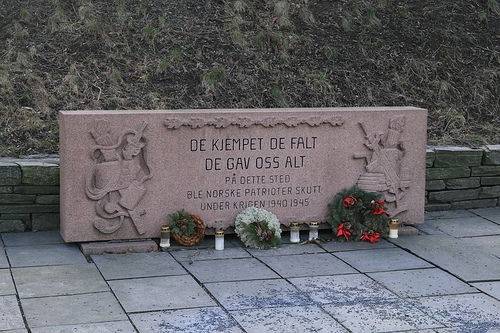
(Photo by Bernt Rostad at http://www.flickr.com/photos/brostad/2290845430/)
“DE KJEMPET DE FALT. DE GAV OSS ALT.” (They fought here and they fell. They gave us everything.) The inscription on a memorial at Akershus Fortress in Oslo, Norway, in honor of the brave WWII Resistance Fighters who were imprisoned and executed there by the Germans.
When war broke out in Europe in late 1939, the Norwegian government repeated a successful tactic from the First World War and declared neutrality. Trade agreements secured with Germany and Great Britain in early 1940 were thought to be an additional protection against invaders, as was Norway’s military presence on its national borders and the close proximity of Britain’s naval power.
With utter surprise, then, did Norway find itself in the talons of the German eagle on April 9, 1940. The massive Nazi invasion by land, sea, and air — the first of its kind in history — conquered eight strategic Norwegian cities within 24 hours. Despite the support of British, French, and Polish allies, the brutal onslaught pushed King Haakon VII and his administration into exile within two months. The wide-sweeping Nazification of Norway began in earnest.
Hitler’s well-planned invasion of Norway on April 9, 1940, caused chaos and death – but not demoralization. The profound patriotism of the Norwegian people soared to only greater heights in the rubble of war, and a heroic Resistance Movement began almost immediately. Hundreds of thousands were eventually involved in some sort of underground activity, and military and civilian arms of the Resistance sometimes worked in tandem with each other. Clandestine operations were so successful that close family members were oftentimes unaware of each other’s involvement until after the war.
Milorg, an underground military organization that evolved into the national Hjemmestyrkere (Home Forces), was officially formed in May 1941 and was recognized by the exiled Norwegian government in November 1941. By the end of the war in May 1945 it had “trained and supplied 40,000 soldiers” (read link). XU, members of Milorg who split from the organization in 1941 as a precaution against detection by the German occupiers, worked closely with Allied forces. “The existence of XU wasn’t made known to the general public until around 1980 ” (read link).
The KK (Coordination Committee) directed the civilian resistance and oversaw matters regarding the schools, churches, homes, and the prolific underground press. Kretsen (The Circle) coordinated with the KK and addressed economic and political concerns via steady but clandestine contact with King Haakon VII and his leaders in London.
During the latter part of the war, the diverse underground organizations began to operate under a single umbrella known as The Leadership of the Resistance. In addition, Norwegians were recruited and trained in Great Britain for the SIS (Special Intelligence Service) and the SOE (Special Operations Executive). The SIS was the first organization to establish clandestine radio contact from Norway to Great Britain in June 1940.
Heroes continued to emerge in spite of threats of imprisonment and execution, and some are well-known even today: Gunnar Sønsteby, a daring and innovative Resistance Fighter who was awarded his country’s highest honors; Leif Hovelsen, who was victorious even after betrayal, torture and a death sentence; Knut Haukelid, a Norwegian-American who was one of the ten successful saboteurs of the heavy water plant at Telemark.
Untold others deserve recognition. Kåre Haukland was a teenager-turned-Resistance Fighter whose badly-scarred body bore evidence of incarceration in Oslo’s infamous Grini prison and also as a prisoner of war in Germany. Kolbjørn Varmann was a Lutheran minister who fearlessly denounced Hitler from his church’s pulpit and secretly spirited Jews to Sweden. Knut and Haldis Einarsen fled for their lives on skis from Norway to Sweden after Knut disabled his family’s commercial ship to prevent its confiscation by Nazis.
Margit Varnes is another little-known Norwegian hero. Seven-months pregnant, she regularly walked 30 minutes at night on a long, treacherous trail to feed four French POWs who had escaped from a German slave labor camp on the island of Otrøy. They were successfully hidden for six months in a massive cave.
Journalist C.E. Chambers interviewed Knut and Haldis Einarsen and Margit Varnes. Their stories are told in “Heroes In Our Backyard” and “Margit’s Secret Cave: Hiding POWs in Dryna, Norway.”
Note: Tusen takk (a thousand thanks) to Arnfinn Moland, historian and researcher from the Norwegian Resistance Museum in Oslo, Norway, for his input in 2003.
(A portion of this article was published by the Sons of Norway Viking magazine in April 2003 as a sidebar to a biography of Margit Varnes that was titled “A Well-Kept Secret.” The author added new material, reworked some other sections, and renamed it “Margit’s Secret Cave: Hiding POWs in Dryna, Norway” for inclusion on this website in May 2011. It was published the same year by the Norwegian American Weekly. )
 MAY 2015:
 C. E. Chambers